

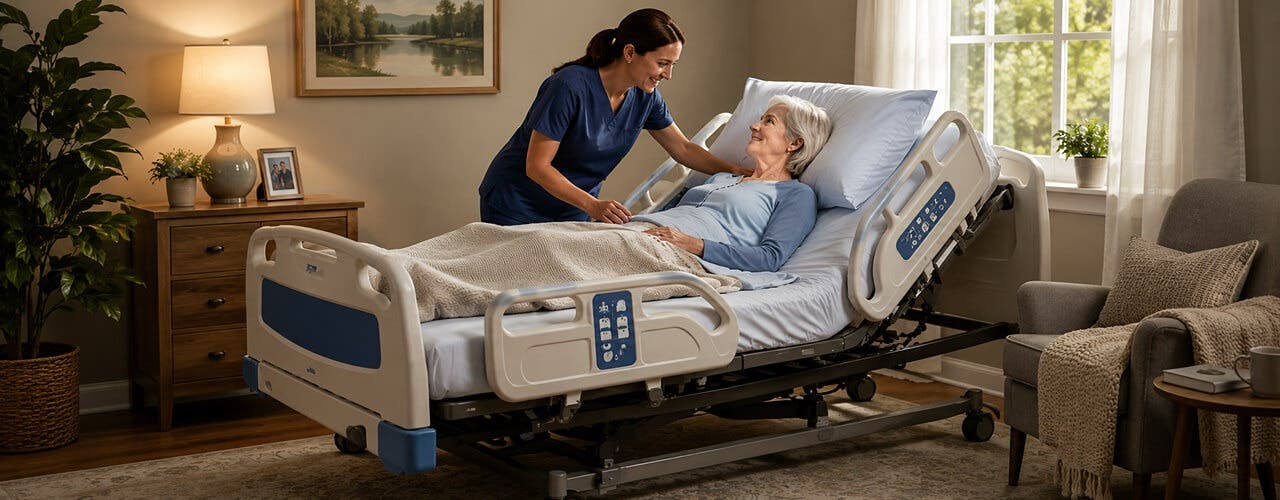
Choosing the Right Hospital Bed for Home Care: A Complete Guide for Families

Transitioning a loved one from hospital to home care is one of the most emotional decisions a family can face. The right equipment can make all the difference — not just for comfort, but for safety, caregiver wellbeing, and recovery outcomes.
Why a Hospital Bed Matters at Home
Standard mattresses lack the adjustability that recovering patients need. A proper hospital bed allows caregivers to position patients at angles that reduce the risk of pressure sores, improve circulation, and make daily tasks — like eating, reading, and receiving medication — significantly more manageable.
Transitioning a loved one from hospital to home care is one of the most emotional decisions a family can face. The right equipment can make all the difference — not just for comfort, but for safety, caregiver wellbeing, and recovery outcomes.
Types of Hospital Beds
- Manual beds — Adjusted by hand crank. Lowest cost, best for short-term recovery.
- Semi-electric beds — Head and foot adjusted electrically; height adjusted manually. Best value for most families.
- Full-electric beds — All positions adjusted electrically, including height. Ideal for patients with limited mobility.
- Bariatric beds — Wider frames (typically 42–48") with higher weight capacities for patients over 350 lbs.
Key Features to Look For
Beyond bed type, focus on mattress compatibility, side rail options, and bed exit alarms. Many caregivers overlook the importance of the bed height range — a bed that descends to 9–11 inches allows patients to get in and out more safely, dramatically reducing fall risk.